
Reviewed · YPRES & WWI BATTLEFIELD TRIPS
Ypres Battlefields and Passchendaele Museum Full Day Tour
Ypres and the Passchendaele area hit you fast, then keep teaching all day. This full day tour strings together key First World War sites in the Ypres Salient, mixing preserved trenches with major cemeteries and a world-class Passchendaele museum.
What I like most is the way the day is guided, not just driven. You get a tight group experience with thoughtful stops, and the tour format gives you time to look closely, not just pose and move on.
One consideration: two big museum moments come with extra ticket cost, since Sanctuary Wood Museum and the Passchendaele Museum admissions are not included in the price.
In This Review
- Key highlights you will feel in real time
- Your day plan in plain terms, from pickup to last crater
- Sanctuary Wood Museum and the preserved trench walk
- Tyne Cot Cemetery, the memorial wall, and what 12,000 graves really means
- The Brooding Soldier and what gas attacks changed in 1915
- Langemark Cemetery, 44,000 burials, and the different mood
- Essex Farm Cemetery, McCrae, and the stories behind young names
- Passchendaele Museum: trenches, dugouts, and a future update
- Hill 60, the Murder Hill nickname, and Caterpillar crater’s underground scale
- Hill 60 (the Murder Hill story)
- Caterpillar Mine Crater (Hill 60 B)
- Price and value: is $288.99 worth it?
- Who this tour suits best, and who might want to think twice
- The booking call: should you book this Ypres Battlefields and Passchendaele Museum tour?
Key highlights you will feel in real time
- A small max group (8 travelers) means you can ask questions and actually hear the answers.
- Trench time at Sanctuary Wood lets you walk part of the preserved British lines, not only read about them.
- Tyne Cot Cemetery at scale: 12,000 graves, plus the memorial wall for 35,000 missing soldiers.
- The Brooding Soldier on gas warfare gives context for the 1915 chemical attacks and why they changed the war.
- Underground warfare at Hill 60 and the Caterpillar crater connects surface fighting to tunnellers and mines.
- A guide like Roger (a published battlefield writer) can add precise, even less-known details, with flexibility on pacing at stops.
More of the Flanders Fields battlefields:
- From IEPER Private 4-hour Tour of the Ypres Battlefield
★ 5.0 · 154 reviews - In Flanders Fields and Passchendaele Half Day Morning Tour
★ 5.0 · 117 reviews - Ypres: An exploration of the deadly salient battlefields
★ 5.0 · 76 reviews - From Ypres, The Christmas Truce to Passchendaele Ypres Based WW1 private tour
★ 5.0 · 29 reviews - From Ypres: WWI Battlefields Private Tour
★ 5.0 · 25 reviews
Your day plan in plain terms, from pickup to last crater
This is a full day, roughly 7 hours, starting at 10:00 am. The base meeting point is Station Ieper, Colaertplein 35, 8900 Ieper, and pickup is offered. If you want pickup, the timing is 9:45 am, from your accommodation in Ypres or from the car park at Ypres Rail station.
That start time matters. You will begin with the most hands-on war setting first, then move through the cemeteries, memorials, and museums while the day is still fresh and light is good for reading names and details.
This tour runs in English and keeps the group size to a maximum of 8. That is not just a comfort perk. In battlefield areas, it helps a lot. You can stand in the same spot long enough to make sense of what you are seeing, and your guide can slow down when a question needs an answer.
Sanctuary Wood Museum and the preserved trench walk
Stop 1 is Sanctuary Wood Museum, and it is a strong opener. The museum experience centers on a rare collection of 3D original battlefield photographs, plus a large set of Great War artifacts, weapons, and uniforms. Then comes the part many people find most memorable: you can walk through an extensive preserved British trench system.
Why this stop is valuable: it sets your mental map before you start visiting cemeteries and memorials. Instead of learning the geography by guessing, you get a lived-in feeling for how trench lines shaped movement, visibility, and survival. Even if you think you know the Western Front, preserved trench sections tend to reset your understanding of how close everything really was.
A practical note: the museum is closed on Mondays. On those days, the tour visits alternative trenches. That is the right approach. You will still get trench time, even if it is not the exact Sanctuary Wood walk you expected.
Also, the admission ticket for this stop is not included, so expect a separate cost here.
Tyne Cot Cemetery, the memorial wall, and what 12,000 graves really means
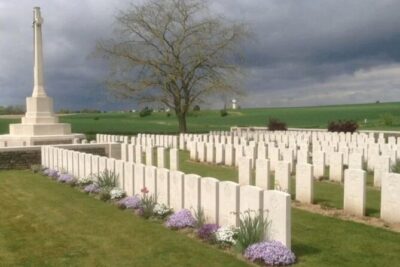
Next you drive through the Passchendaele battlefields area and arrive at Tyne Cot Cemetery. The big number is hard to swallow: it has 12,000 graves and is described as the largest British and Commonwealth war grave cemetery in the world. At the rear is the Tyne Cot Memorial wall, listing names of a further 35,000 soldiers missing with no identified grave.
What makes this stop hit hardest is the combination of physical markers and the absence behind the names. Cemeteries give you bodies. Memorial walls give you the people the war kept hidden.
You typically get about 35 minutes here. That is enough time to do two things well: first, slow down with the headstones and spacing, and second, walk to the memorial wall and read. If you rush, you miss the point. Here, the point is the long list, the repetition of surnames, and the sense that one family could be represented many times in the same war.
The good news: admission is free.
The Brooding Soldier and what gas attacks changed in 1915
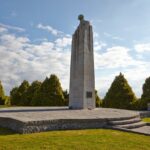
Stop 3 is the St. Julien Canadian 2nd Battle of Ypres Memorial, known as The Brooding Soldier. This iconic Canadian monument and garden commemorates Canadian soldiers lost in the gas attacks of 1915.
The value of this stop is in the explanation of chemical warfare in the Ypres Salient. You will learn about the gas attacks of 1915 and how chemical weapons altered the nature of fear and battlefield tactics. It also helps you understand why some Ypres memorials do not focus only on names and dates. They focus on a specific kind of horror that the war machinery produced.
This stop is shorter, about 20 minutes, and admission is free. For me, that length is workable because it is focused. You get the key context and then move on before the atmosphere turns heavy in a way that makes it harder to stay present.
More Museum Visits in Ypres:




Langemark Cemetery, 44,000 burials, and the different mood
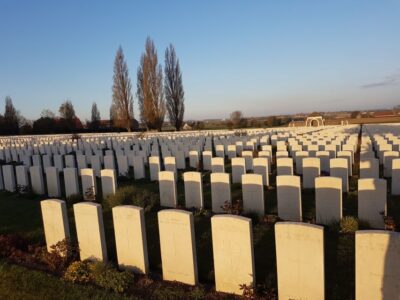
At Langemark Cemetery, you visit the second largest German cemetery in the area, with 44,000 burials. It feels different from the British and Commonwealth cemeteries, and the tour explanation helps you understand why. The site design is said to have been heavily influenced by the Nazis of WW2, and some of that influence is still visible today.
The centerpiece is a mass grave at the center, and it is described as mind blowing in scale. That word gets used a lot in travel, but the reality here is simple: when a cemetery organizes bodies into a huge collective statement, you feel it in your chest. It is not just remembrance. It is architecture of loss.
Expect around 25 minutes and free admission.
If you are sensitive to visual propaganda or heavy symbolism, this stop may feel intense. It is also one of the reasons it matters to visit with a guide who can explain what you are seeing without turning it into a spectacle.
One optional idea mentioned for preparation: you might consider reading Studentenfriedhof to Soldatenfriedhof, written in English. It is suggested as a helpful way to get context on the cemetery’s history before you arrive.
Essex Farm Cemetery, McCrae, and the stories behind young names
Stop 5 is Essex Farm Cemetery. This is where the tour shifts from major monument scale to smaller human-scale stories.
You visit preserved dressing station bunkers, which are tied to the process of wounded evacuation. Then you see a memorial to Lt Col John McCrae, connecting the site to the story of In Flanders Fields and how that poem influenced remembrance over time.
This stop also includes a grave of Valentine Strudwick, killed at age 15. Learning his story gives weight to the topic of underage soldiers in the Great War.
Why this stop works: it turns cemetery visiting from a checklist into a narrative. You see the place where people were treated and organized, and you connect it to language that later generations used to keep the war from vanishing.
You typically get 30 minutes, and admission is free.
Passchendaele Museum: trenches, dugouts, and a future update
Stop 6 is Passchendaele Museum, described as world class. You get replica British and German trenches, plus an underground replica dugout experience and the museum’s new Battle of Passchendaele immersive room. The focus is squarely on the Battle of Passchendaele, the combatants, and what the ground war meant.
This is usually about 1 hour 30 minutes, so it functions like your centerpiece break. After cemeteries and memorials, a museum stop gives your brain a structured way to interpret what you already saw. You can see cause and effect instead of only grief and remembrance.
A useful practical detail: the museum admission ticket is not included. Also, you should know the museum is described as being updated ready for 2025. If you care about seeing the latest setup, this future-ready note can be reassuring.
If you like hands-on learning, the replica trenches and underground dugout elements are the main reason this works. If you prefer quiet and reading, you may still find value here, but it is likely to feel more physical than you expect.
Hill 60, the Murder Hill nickname, and Caterpillar crater’s underground scale
You finish the day with two linked, high-impact battlefield sites.
Hill 60 (the Murder Hill story)
Stop 7 is Hill 60, named by British soldiers as the Murder Hill. You walk over a preserved battlefield area with bunkers and mine craters. Today, it is an official war grave, and the tour explanation notes that remains of soldiers and tunnellers are concealed beneath the surface.
The tour discusses fighting at Hill 60 with a focus on both 1915 and 1917 and the underground war. It also highlights how compact the battlefield was, with soldiers separated by only a few meters of ground. That kind of closeness is a key reason the Ypres Salient feels so different from open-field battle maps. It is not big, clean space. It is tight, shattered space.
You get 35 minutes, and admission is free.
Caterpillar Mine Crater (Hill 60 B)
Stop 8 is the Caterpillar Mine Crater, also referred to as Hill 60 B. This is tied to the story of the war underground and the battle of Messines Ridge. The key detail here is June 7th, 1917, when the British and Commonwealth tunnellers blew 19 massive underground mines. The Caterpillar crater is described as the best preserved of those craters.
The contrast is the point: breathtaking scale and beauty, set against the horrors that happened there. You will likely come away with a clearer sense of why the underground war was its own front line, not a side project.
This stop runs about 30 minutes, and admission is free.
Price and value: is $288.99 worth it?
At $288.99 per person, this is not a cheap day trip. The value comes from what you are buying besides transportation.
First, you are paying for a guided route through several sites that each carry a lot of context. In the Ypres Salient, the difference between a good visit and a memorable one is almost always interpretation. The tour format gives you a guide who can connect trenches, cemeteries, and memorials into one coherent understanding.
Second, the group size cap of 8 travelers is part of the value equation. On a battlefield tour, a small group helps with pacing. You spend time where it counts, and you are not trapped in a rushed rhythm.
Third, the itinerary includes a mix of memorials, cemeteries, and learning-focused stops, including the Passchendaele Museum and the Sanctuary Wood trench system. That combination is hard to DIY well without losing time.
Now, the reality check: two major admissions are not included, so your final spend will be higher than the listed price. Still, if you want trench access, museum depth, and underground battle context in one day, this pricing can make sense.
For budget planning, think of the money as covering guide time, sequencing, and making the day feel purposeful.
Who this tour suits best, and who might want to think twice
This tour suits you if you:
- want a structured Ypres battlefields day without guessing the order
- enjoy learning from a guide, especially someone who can add precise details at each site
- are comfortable with emotionally heavy places like major cemeteries and memorial walls
- like museums that include practical, hands-on replicas and an underground experience
You might think twice if:
- you do not want to add museum ticket costs for Sanctuary Wood and Passchendaele Museum
- long stops in cemeteries feel overwhelming without breaks
- your schedule is too tight for a full day with about 7 hours on the go
Also, note that the tour states most travelers can participate. That is not a guarantee about specific physical requirements at every stop, but it suggests the overall activity is broadly approachable.
The booking call: should you book this Ypres Battlefields and Passchendaele Museum tour?
If you care about understanding the Ypres Salient, this is the kind of day that pays off. The biggest reason to book is not any single stop. It is the way the day moves from trenches to cemeteries to specific story points like gas warfare, then back to the underground fighting at Hill 60 and Caterpillar crater.
Book it if you want an organized, small-group day that makes monuments and graves readable, not just visible. Skip it only if you strongly prefer independent touring, or if you know you will struggle with the emotional weight of war cemeteries and memorials.
Latest from Ypres




Ypres & WWI Battlefield Trips, compared.
Great War Flanders Fields Minibus Tour w/ Lunch
Read our review →
Flanders Fields Remembrance Tour from Brussels
Read our review →
From IEPER Private 4-hour Tour of the Ypres Battlefield
Read our review →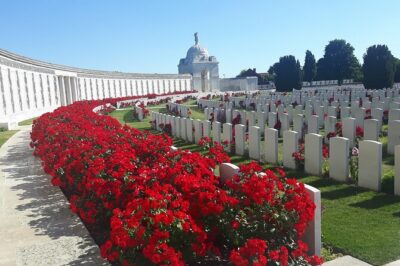
In Flanders Fields and Passchendaele Half Day Morning Tour
Read our review →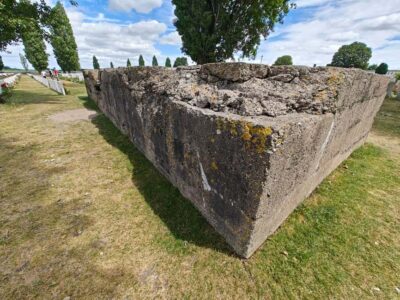
An exploration of the deadly salient battlefields
Read our review →
Small Group Ypres Remembrance Day Filled With War History
Read our review →Browse the lists this tour appears in