Reviewed · CITY TOURS
Private Antwerp City and Port Vespa Tour with an Expert Guide
A scooter ride through a working port feels wild. On this private Antwerp Vespa City and Port tour, you’ll roll from leafy old-town lanes to towering terminals, with a guide who turns industrial sights into a clear story you can see and smell.
I especially love the port focus. You’re not just looking at cranes from a distance, you’re learning what they do, how logistics flows, and why this part of Antwerp shapes daily life. The second thing I like is the pace and format, two gleaming Vespas moving as a mini convoy, so you get constant sightline time without standing around.
One drawback to plan for: this experience depends on good weather. If the day is rough, you may be offered a different date or a full refund, so keep some flexibility in your schedule.
In This Review
- Key highlights you will feel in Antwerp
- Private Vespa touring: why this Antwerp port route works
- How the tour runs: safety spin, convoy signals, and who drives
- Starting at Stadspark: safety practice plus first old-town glide
- MAS viewpoints: Museum aan de Stroom as your port orientation
- Het Eilandje and Red Star Line quays: cranes, trade routes, and big silhouettes
- Havenhuis contrast: Zaha Hadid design across old dry docks
- Oosterweel and Kastelweg: a medieval spire beside Europe’s largest wharf
- Katoen Natie at Noordkasteel: smart logistics in action
- Timber, fruit, and the Oosterweelbrug docks: scents from a century of shipping
- Lubeckweg container canyon and Ettenhovendijkweg hump yard: how scale looks close up
- Kuifeend nature pause at Noorderlaan: steel and concrete, then reeds
- Price and value: what $592.66 per group buys you
- Who should book this Vespa port tour
- Quick practical tips for a smoother ride
- Should you book Antwerp Port Tours by Vespa?
- FAQ
- How long is the Private Antwerp City and Port Vespa Tour?
- What is the price for the tour?
- Is this a private tour?
- Where do we meet for the tour?
- What are the age requirements for drivers and passengers?
- What ticket type will I receive?
- Does the tour run in all weather?
- What is the cancellation policy?
Key highlights you will feel in Antwerp
- Private Vespa setup with one driver and one passenger per scooter, up to 4 people total
- Stadspark to MAS for quick orientation, before the tour shifts into port mode
- Het Eilandje and Red Star Line docks where Antwerp’s trade and travel past is visible in the quays
- Zaha Hadid meets dry docks at Havenhuis with a striking modern building across the water
- Kuifeend wetland stop that swaps steel and containers for reed beds and a short nature walk
More City Sightseeing in Antwerp
- Antwerp: City Highlights Walking Tour
★ 4.7 · 816 reviews - Antwerp: City Highlights Guided Bike Tour
★ 4.7 · 529 reviews - Antwerp: Historical Walking Tour in the Old City
★ 4.8 · 373 reviews - Historical Walking Tour in Antwerp Old City
★ 5.0 · 277 reviews - Antwerp: City Brewery De Koninck Interactive Tour
★ 4.6 · 258 reviews
Private Vespa touring: why this Antwerp port route works
I like tours that give you context fast, and this one does it. You start in the city, then the tour gently ramps into the port, so the scale makes sense instead of feeling random. The best part is that the guide uses the real sights around you, terracotta towers, diamond-glass shapes, and container rows that look close enough to read.
You also get a senses-on-the-move experience, not a museum-only one. Expect the Vespa hum under you, gull cries over the water, and the practical sounds of port work, including clanking container hardware. Your nose gets in on it too, with mentions of coffee in Antwerp’s main coffee hub area, woody imported timber notes, and the sweet smell of fruit sheds when unloads and storage line up that day.
If you enjoy getting your bearings without hours of walking, the Vespa format is the win. In a single morning-style outing, you connect medieval city textures to the mega-docks world in a way that feels like one continuous story.
How the tour runs: safety spin, convoy signals, and who drives
You’ll meet at Mercure Antwerp City Centre, Quinten Matsijslei 25, and the tour begins right in the center of things. After you’re matched with your scooter, you clip on a helmet and get a quick safety spin. The guide also covers convoy signals, which matters once you move between busy-adjacent streets and port roads.
Each of the two Vespas carries one driver and one passenger. That means you can go as a couple, a pair of friends, or a small family setup with the right ages. The minimum age for a driver is 26, and the minimum age for a passenger is 16. If you have teens traveling with you, this matters for who can ride as passenger.
Because it is private, you’re not squeezed into a large group rhythm. It’s designed for your unit of up to four people, so you can ask questions and get answers tied to what’s directly in front of you.
Starting at Stadspark: safety practice plus first old-town glide
Stadspark is a smart first stop because it resets your senses. Before the port scale hits, you start with calmer green space and a smoother transition from city traffic to guided riding. Your guide starts you by positioning the group, fits helmets, and runs through the basic signals you’ll need during the ride.
The goal here is simple: by the time you leave Stadspark, you should feel comfortable with the scooter rhythm and confident that the guide has a plan. It’s the kind of start that prevents the rest of the tour from feeling like you’re always thinking about the mechanics of riding.
You also get early visual variety, the kind that keeps your brain engaged. You’re still close to the classic Antwerp feel, and you’re already noticing building shapes and street textures that later contrast with the port’s modern forms.
MAS viewpoints: Museum aan de Stroom as your port orientation
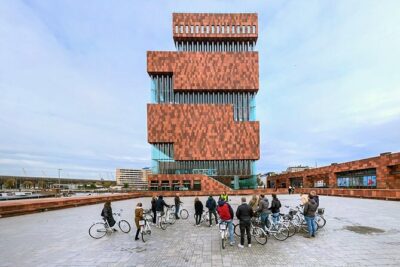
After Stadspark, you head to MAS, the Museum aan de Stroom. The terracotta tower gives you a dramatic landmark, and the guide pauses you by the riverside promenade so you can take your first real look into the port world.
This is where the tour does a useful thing for your trip planning. Seeing the river and industrial edges from MAS helps you understand how Antwerp is laid out. It’s easier to follow later stops when you already know where the big lines run, water here, quays there, and terminals beyond.
This short viewpoint moment is also practical. You get a chance to adjust your expectations for the rest of the ride, and you can spot what kinds of scenes you’re about to see, cranes, docks, and large-scale structures.
Still got an afternoon? Try these:
Het Eilandje and Red Star Line quays: cranes, trade routes, and big silhouettes
The Historic Docklands drive takes you through Het Eilandje, and the scene immediately shifts in a way that’s hard to replicate on foot. You pass towering iron cranes, described as silent sentinels of Antwerp’s sail-to-steam heyday, and it gives you the sense that the port has changed, but the shapes that tell the story remain.
This is also where the Red Star Line connection comes into focus. Even if you’re not aiming to memorize dates, you’ll get a clearer feeling for Antwerp as a gateway city, a place people and goods moved through. The guide’s job is to connect the visual clues, the quays and the waterfront geometry, to the wider trade and travel patterns.
One tip: keep your phone ready but do it lightly. This part is about noticing scale. If you spend too long filming, you might miss the small explanations the guide points out, like how different dock areas hint at different eras of shipping.
Havenhuis contrast: Zaha Hadid design across old dry docks
Then comes one of the most memorable “wait, what am I looking at?” stops. At Havenhuis, you get a pier-side viewpoint across the water. The building is described as diamond-glass and shaped in a way that feels futuristic, yet it sits opposite older dry-dock structures, including a 19th-century fire station setting.
That contrast matters because port areas often feel like one long industrial stretch. Here, you get a clear moment where modern architecture meets older infrastructure, and you can see how a working port site adapts instead of freezing in time.
This stop is brief, about 10 minutes, but it functions like a visual hinge. After this, the tour becomes more about logistics detail and less about learning the big “why” from the older waterfront feel.
Oosterweel and Kastelweg: a medieval spire beside Europe’s largest wharf
Kastelweg brings one of the tour’s best “two worlds at once” comparisons. You glide past a small 15th-century Oosterweel church, while right next to it you see the colossal construction yard and the scale of a major wharf area.
For me, this is where Antwerp’s identity becomes easiest to grasp. Antwerp isn’t either historic or modern. It’s both, sometimes literally in the same view. That tiny medieval spire next to massive port construction does something walking tours struggle to show in one glance.
It also helps you understand what your guide means when they talk about ongoing change. The port is not just heritage. It is active, expanding, and under constant redevelopment, which is why some sights feel new and some feel old.
Katoen Natie at Noordkasteel: smart logistics in action
At Noordkasteel, you park by the towering white granulate silos of Katoen Natie. Even if you don’t consider yourself a logistics person, it’s a fascinating moment because you can see how a single industrial function becomes a whole system.
The guide explains how this family firm turned plastics handling into a data-driven operation. You might not see the software running, but you will see the physical clues, the silo structures, storage arrangements, and how this kind of site supports continuous movement rather than one-time shipping events.
This stop is also a reminder that “port” is not just ships and water. It’s storage, processing, and planning. If you like to travel by learning how things work behind the scenes, this part delivers.
Timber, fruit, and the Oosterweelbrug docks: scents from a century of shipping
Oosterweelbrug is the part I’d recommend to your sense of smell. The tour describes it as rolling into heritage docks where Europe’s largest timber stacks and chilled fruit sheds still play a major role. Depending on the day’s unload, the air can carry sweet fruit notes and salty Scheldt air, plus the woody tang of timber.
This is the sort of detail that makes a city trip feel real. It’s not generic sightseeing. It’s specific to what is being handled in that space that day. The guide uses those smells and visuals to help you understand the cargo logic, why certain facilities exist, and why the port’s layout favors bulk storage.
You’ll also notice that the visuals stay readable even when the scale is big. Stacks, sheds, and quays create patterns. Those patterns make it easier to remember where you are and what each area does.
Lubeckweg container canyon and Ettenhovendijkweg hump yard: how scale looks close up
Next you get the container canyon effect at Lubeckweg. You ride through multicolored container stacks where the guide points out you can read box seals from close enough. That closeness is key. When you see containers packed tightly, it stops being abstract global trade and becomes physical, countable, and immediate.
Then the tour shifts to rail at Ettenhovendijkweg, with a drive-by of Antwerp-North hump yard. You’ll peer down on marshalling yards, described as a spiderweb of tracks where up to a thousand wagons are reshuffled each day. Even if you only take in a portion of what you see, the guide’s explanation helps you understand how the rail network keeps the port fed and connected.
This is one area where motion matters. From a parked viewpoint you could miss the dynamic logic. On a Vespa, you’re moving alongside the industrial geometry, and it becomes easier to visualize how cargo changes hands as it flows between ship, truck, and rail.
Kuifeend nature pause at Noorderlaan: steel and concrete, then reeds
Just when you might think you’ve seen all the “port life” scenes you can handle, the tour offers a counterbalance at Noorderlaan. You park beside reed-fringed ponds of Kuifeend and step off for a short trail.
This stop switches your experience from cargo to ecosystem. You still feel the port presence nearby, but the sound and visuals change. The guide frames it as a wetland refuge amid steel and concrete, and that description rings true the moment you walk among the reeds.
This is also a nice energy reset for your body. After hours of riding past large structures, a short nature segment gives you a moment to stretch your legs and clear your head.
Price and value: what $592.66 per group buys you
The price is listed as $592.66 per group, up to four people. That number will read like a lot if you compare it to walking tours. But this isn’t a walking tour. You’re paying for a private Vespa experience, guided by an expert port guide, with two scooters running together for your group.
In real value terms, the Vespa format cuts down on time, and the guide’s focus on working port sites gives you more than sightseeing photos. You also get a structured route with multiple distinct environments, city park to MAS viewpoint, older docks to modern dry-dock contrasts, and then rail yard and wetland pause.
If you travel in a pair of two, the cost per person can feel more reasonable compared with a solo experience. If you’re traveling as a small group of four, it can become a strong way to see Antwerp’s port side without splitting your day into multiple transport modes.
Who should book this Vespa port tour
I think this tour fits you if you like practical travel, hands-on observation, and stories tied to real machinery and real operations. It is also a good match if you want to see Antwerp beyond the usual city center sights, but you don’t want to spend your whole day doing long walking distances.
It’s especially suitable for:
- Couples and small friend groups with at least one rider who meets the 26 driver minimum
- People who enjoy photography but also want the explanations behind what they photograph
- Travelers who like transport-based sightseeing, scooter riding included
If everyone in your group is under the driver age requirement, you may need to rethink who rides and how your group can meet the tour’s minimums.
Quick practical tips for a smoother ride
Bring layers. Even in warmer months, dockside shade and river breezes can feel cooler than city air. Closed-toe shoes help for comfortable footing while you park and dismount at stops.
Pay attention to helmet fit and listen closely during the safety spin. Once you’re rolling, you’ll want to focus on what the guide is pointing out, because several of the best moments are tied to quick sight angles, like the contrast between old waterfront shapes and newer container or logistics infrastructure.
Also, plan your day around this being a weather-dependent experience. If the forecast looks shaky, keep an alternate plan for the day around your tour start time.
Should you book Antwerp Port Tours by Vespa?
I’d book this if you want a fast, memorable way to understand Antwerp as a working port city, not just a pretty stop. The combination of private scooter riding and port-specific expert guidance is what makes it feel different from standard city sightseeing.
You’re likely to appreciate the way the route alternates scale and mood, big cranes and container stacks, then a modern architectural moment at Havenhuis, then a calmer nature pause at Kuifeend. That rhythm helps the tour stay interesting without feeling like one long industrial stare.
If you hate weather-dependent plans or you’re uncomfortable riding a scooter, you might prefer a more traditional walking or seated format. But if you can handle the basics, this is one of the best ways to connect Antwerp’s city identity to the docks that drive it.
FAQ
How long is the Private Antwerp City and Port Vespa Tour?
The tour runs about 2 hours 30 minutes to 3 hours 30 minutes.
What is the price for the tour?
The price is $592.66 per group, for up to 4 people.
Is this a private tour?
Yes. It is private, so only your group participates.
Where do we meet for the tour?
You meet at Mercure Antwerp City Centre, Quinten Matsijslei 25, 2018 Antwerpen, Belgium, and the tour ends back at the meeting point.
What are the age requirements for drivers and passengers?
The minimum age for a driver is 26. The minimum age for a passenger is 16.
What ticket type will I receive?
You’ll receive a mobile ticket.
Does the tour run in all weather?
This experience requires good weather. If it’s canceled due to poor weather, you’ll be offered a different date or a full refund.
What is the cancellation policy?
You can cancel for free up to 24 hours in advance for a full refund. If you cancel less than 24 hours before the start time, the amount paid is not refunded. Changes within 24 hours are not accepted.
More Scooter Rentals in Antwerp
- Antwerp: Full Day Bike Rental
★ 4.7 · 12 reviews - From Bruges to Damme: Private Electric Scooter tour
★ 4.8 · 194 reviews - Ghent guided offroad tour by e-scooter
★ 5.0 · 42 reviews - Bruges: E-Bike Rental and Trip Tips
★ 5.0 · 12 reviews