
Reviewed · SHORE EXCURSIONS
Guided Antwerp Port Tour, in your Car or Minibus
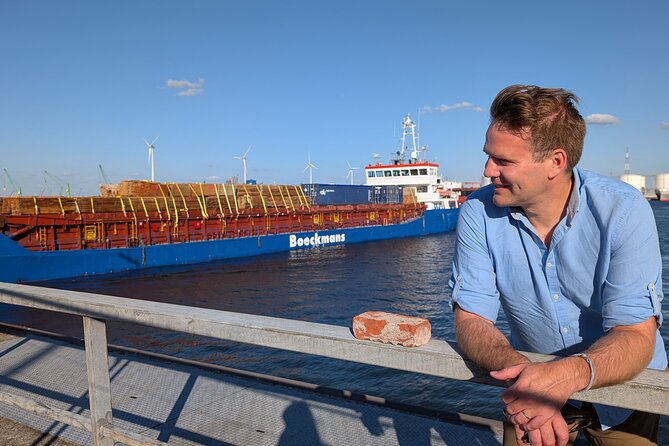
The port feels like a moving machine. You’ll ride the perimeter by car or minibus and get close to Antwerp’s industrial scale and human stories in one 2.5 hour loop. I like how the stops mix big engineering moments with small human details, and how guides like Niki and Laurens bring it to life in English.
Two standouts for me are the photo-ready start by Havenhuis Vantage and the quiet intensity of the lock areas, where you can feel how much logistics runs on signals and timing. One consideration: this is an outdoor-heavy port experience, and it’s not recommended for anyone with serious respiratory diseases, plus it needs good weather.
In This Review
- Key Highlights You Should Know
- The Start at Droogdokkenweg and Havenhuis Vantage
- Oosterweel: From a 15th-Century Spire to Europe’s Biggest Wharf
- Scheldelaan Duality: Chemical Giants and the Graffiti Wall
- Boudewijnsluis and Locks: Workhorse Gates You Can Understand
- Berendrecht Lock and the PSA Riverside Overlook
- Lillo: The Windmill Marker and the Fort That Feels Nearby
- Antwerp-North Hump Yard: Rail Logistics in Motion
- Lillo Container Canyon: Granite Blocks and Europe’s Fruit Terminal
- Price, Timing, and Value for a Group of Up to 15
- Transportation and Meeting Point: Where to Start and What to Bring
- Best For and Who Should Skip It
- Should You Book This Antwerp Port Tour?
- FAQ
- How much is the Antwerp Port Tour, and is it per person?
- How long does the tour last?
- What language is the tour offered in?
- Do I need a vehicle, or is a bus provided?
- Where do we meet, and where does it end?
- Is there a mobile ticket?
- Is the tour private?
- Is it suitable for children or for people with respiratory issues?
- Are service animals allowed, and what about weather?
Key Highlights You Should Know
- Havenhuis Vantage meets dry docks for design and port-meets-art photos
- Oosterweel contrast drive past a medieval church to Europe’s largest wharf
- Scheldelaan duality chemical tanks on one side, an international graffiti wall on the other
- Boudewijn and Van Cauwelaert locks show how small gates keep supply lines flowing
- Lillo Fort time-warp with geese, ramparts, and smuggler-era atmosphere
More shore excursions from Zeebrugge:
- Antwerp: Private Port Tour with Expert Guide and Car
★ 5.0 · 1 review - Deluxe Bruges Shore Excursion from Zeebrugge Cruise Port
★ 4.5 · 80 reviews - Best Bruges Shore Excursion – Small Group + Optional Canal Cruise
★ 4.5 · 62 reviews - Best Bruges Shore Excursion including Deluxe Canal Cruise
★ 4.0 · 27 reviews - 6 Hour Bruges Shore Excursion from Zeebrugge Cruise Port
★ 4.5 · 23 reviews
The Start at Droogdokkenweg and Havenhuis Vantage
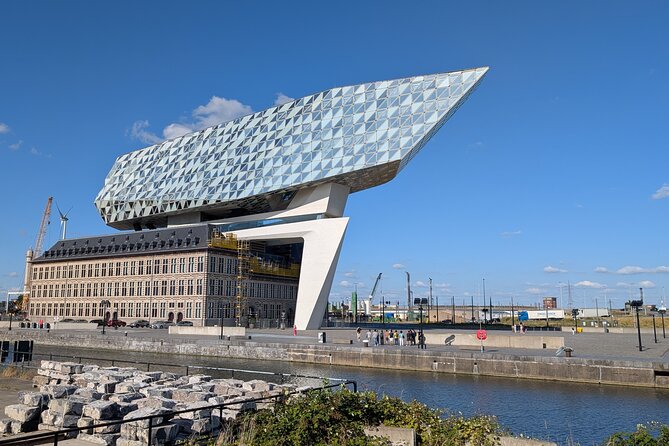
The tour kicks off at a quiet pier opposite Havenhuis Vantage, where Zaha Hadid’s design looks like it belongs to a futuristic ship. The view is striking, because you’re framed by the shimmering glass structure and the historic dry docks that the city is turning into a Maritime Museum.
What makes this first stop work is the way it sets expectations. This is not a lecture in a classroom. Your guide points out design choices, then ties them back to why the dry dock story matters: these basins were built for a different pace of maritime life, and now the area is being reactivated for visitors.
Practical tip: bring your camera early. This is one of those places where your first wide shots will beat your later ones, because the light and angles can be best right when you disembark at the pier.
Oosterweel: From a 15th-Century Spire to Europe’s Biggest Wharf
You’ll roll past the tiny Oosterweel church, a leftover medieval marker sitting beside one of today’s biggest infrastructure sites. The guide connects it quickly and clearly: Oosterweel works are Europe’s largest wharf, and it’s busy casting tunnel segments for Antwerp’s Ring closure.
This is one of the most interesting stretches of the drive because the contrast is so direct. You’re literally watching history and modern construction share the same river corridor, with the scale of the port making medieval proportions feel very small.
A good way to look at it: forget the idea that ports are only about ships. This section shows the port as a fabrication hub, where major road and tunnel components get produced right next to the water.
Scheldelaan Duality: Chemical Giants and the Graffiti Wall
As you head along Scheldelaan, your guide turns the car into a moving viewpoint, with two sides of Antwerp’s port world pulling your attention at the same time. On one side, you’ll see stainless tanks, tall processing units, and the steady drama of steam plumes connected to Europe’s second-largest chemical cluster. On the other side, a long flood wall explodes with colour from the annual international graffiti contest.
The smartest part here is how your guide explains the hidden systems. You’ll hear how pipelines run under the roadway, like arteries you can’t see but can infer from what’s above ground. That connection changes the way you read the whole area. After that, you start spotting patterns: where you’d expect movement, where you’d expect storage, and how the port keeps working even when you’re not watching vessels.
If you like contrasts, this is the emotional heart of the drive, because it shows the port is not only industrial. It’s also culture, youth, and a kind of temporary street-art energy happening right alongside heavy industry.
Boudewijnsluis and Locks: Workhorse Gates You Can Understand
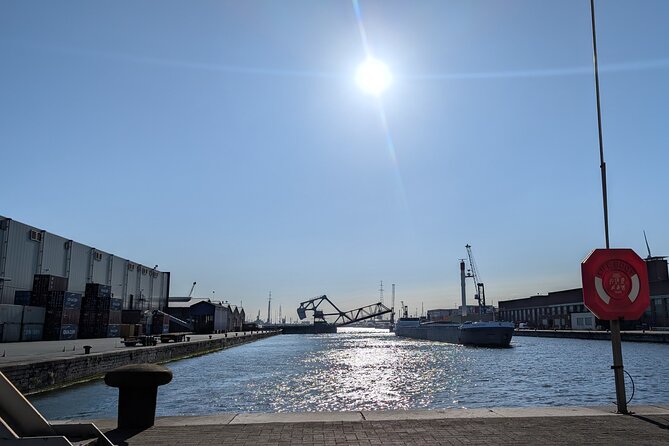
Stop two brings you out by De Vaarkom basin, with chemical stacks on one side and the twin Boudewijn and Van Cauwelaert locks on the other. The locks may look modest compared to the giants you’ll see later, but they’re vital because barges and short-sea traffic rely on them constantly.
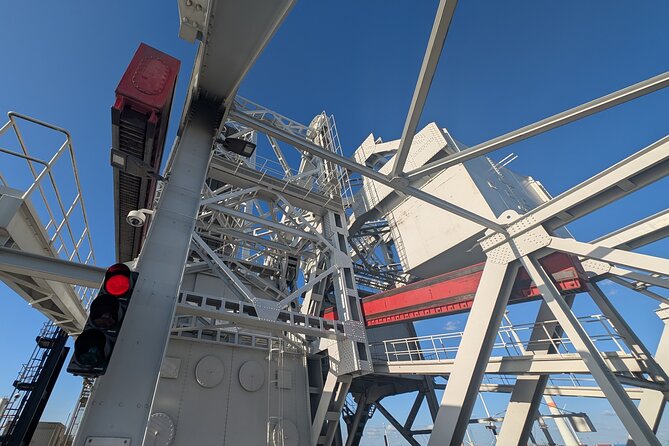
What you’ll pay attention to here is the human control layer. Your guide explains lock-master signals, points out things you might notice like bow thruster turbulence underfoot, and frames the locks as workhorse gates that keep refinery supply lines moving day and night.
Watching tugs nudge short-sea freighters through narrow sluices is an excellent warm-up for the larger spectacle later. Even if you’re not a ship-spotting expert, you’ll leave this section understanding how much precision matters. In ports, the action isn’t only the ship. It’s the choreography around the ship.
Practical consideration: this stop is one of the best for people who enjoy operations. If you just want big ships and skyline views, you might find it quieter than you expected, but it’s still very rewarding.
A few more Antwerp afternoons to weigh up
Berendrecht Lock and the PSA Riverside Overlook
Next, you’ll get a fly-by of Berendrecht Lock, which your guide frames as one of the world’s biggest sea locks and the main doorway to the docks beyond. Even without a vessel passing at the exact moment, the scale is the point. The guide’s commentary helps you visualize what’s happening behind the scenes: tugboat coordination, line-handlers, and the tight timing that keeps ships moving safely through massive openings.
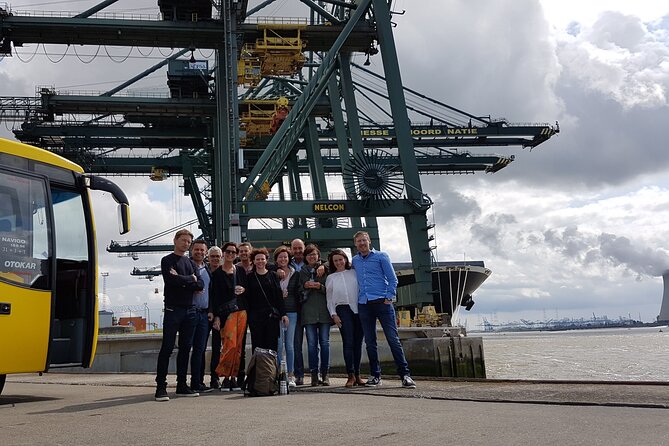
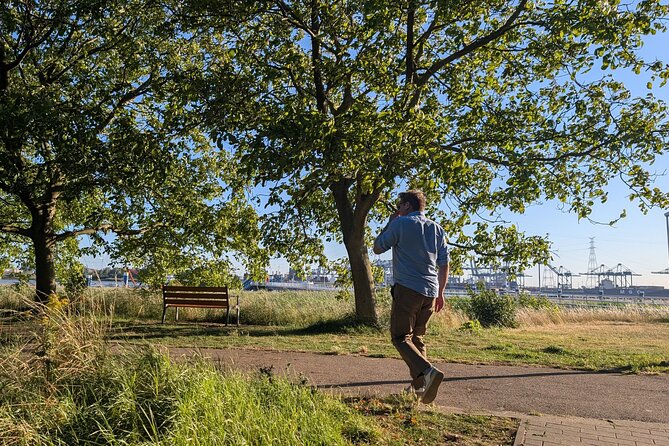
Then you’ll step out at Dock 910 in the Zandvlietweg area near PSA quays, one of those viewpoints where multiple stories happen at once. From this single overlook, you can connect the dots between container handling in motion, the Berendrecht and Zandvliet locks behind you, and the Belgium-Netherlands border line mid-stream. On top of that, you can spot the twin cooling towers of the Doel nuclear plant in the distance.
This is the “systems view” stop. You’ll feel how the port functions like a network instead of a collection of sites. Containers go in one direction, locks manage flow, borders mark jurisdiction, and utilities scale up in the background. If you like learning how cities run, this is very satisfying.
Lillo: The Windmill Marker and the Fort That Feels Nearby
The tour uses Lillo in two different ways, and that’s part of why it works. First, you’ll see a Lillo windmill drive-by, a solitary brick structure that once served the vanished village of Lillo. Your guide uses it as a ghost marker, explaining how the port sprawl pushed inland and how entire hamlets were bought out and dismantled.
That kind of storytelling adds weight to the word port. It stops being only about industry and becomes about how lives get reshaped by major development.
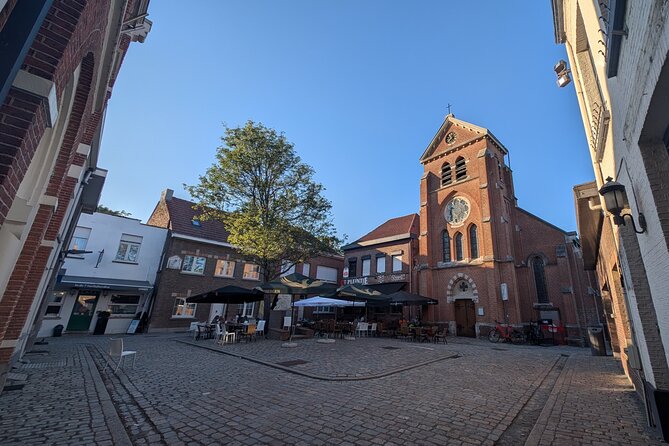
Then you’ll spend time at Lillo Fort, where you trade smokestacks for cobblestones and ramparts. Expect resident geese greeting you on the grassy areas, plus an 18th-century feel with fishermen’s houses and a tiny dock-like setting. Your guide connects this place to Spanish sieges, smugglers, and the community identity that stayed present even while chemical operations grew just across the dike.
The contrast here is the takeaway: Antwerp’s port past and present coexist in the same breath. One moment you’re reading the geometry of infrastructure. The next, you’re hearing a fort story on a rampart while birds move around you.
Antwerp-North Hump Yard: Rail Logistics in Motion
A drive-by at Antwerp-North hump yard gives you a rail systems view, where marshalling yards reshuffle mixed trains. Your guide narrates the gravity-shunting ballet, including the idea of a hump where wagons roll downhill, plus laser sensors and track retarders that slow cars into their right positions.
This stop is great if you’ve ever wondered how rail yards avoid total chaos. The narration turns the yard from background scenery into a kind of machine logic you can follow with your eyes.
The best part is timing. If the yard process lines up with your viewing moment, you can watch the rhythmic clatter and switch logic in action. Even if you don’t catch peak operations, you’ll still come away with a clearer picture of how the port connects road, rail, and river in a single workflow.
Lillo Container Canyon: Granite Blocks and Europe’s Fruit Terminal
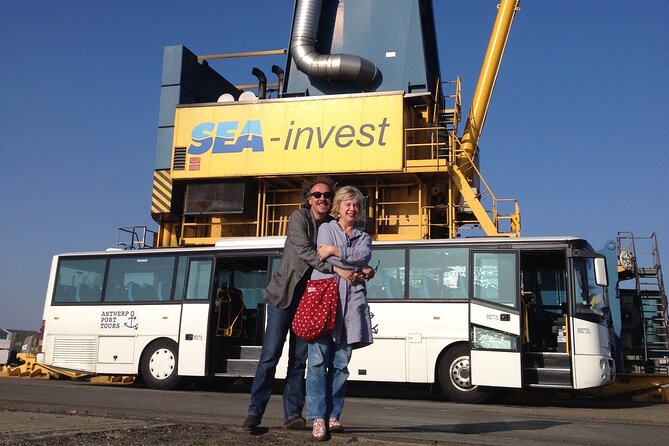
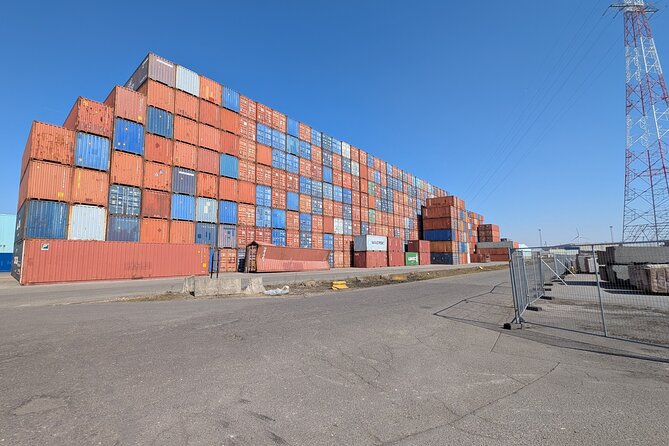
The finale moves into the container canyon feeling, with multicoloured stacks close enough that you can make out box seals. Your guide frames what’s moving through Antwerp by showing two ends of the spectrum.
On one side, you’ll see house-sized granite blocks waiting for export. On the other side, you’ll get a sense of food logistics at Europe’s largest fruit terminal, where refrigerated racks handle bananas and citrus. If you picture a ship arriving, then imagine the time pressure of moving produce, this stop helps you connect the glamour of goods to the practical reality of refrigeration.
This last burst of port life is also a good emotional landing. You get to see how the port is built for volume and speed, not only heavy industry.
Price, Timing, and Value for a Group of Up to 15
The price is $314.42 per group, sized for up to 15 people. For a family or small group, that can be excellent value, because you’re effectively paying for a guide and a route that strings together multiple port zones that you might otherwise miss.
The timing matters, too. The tour runs about 2 hours 30 minutes, which is long enough to see the key systems without turning into a full half-day grind. Short stops like the quick 10-minute viewpoint breaks keep the momentum, while the longer Lillo Fort segment gives you room to actually feel the place instead of rushing past it.
What you should plan for: it’s in English, and you’ll want to sit where you have clear sightlines out of the vehicle. If your group includes people who learn best by images, you’ll likely be the happiest when you’re ready to photograph at the first few stops.
Transportation and Meeting Point: Where to Start and What to Bring
You’ll meet at Kinepolis Antwerpen, Groenendaallaan 394, 2030 Antwerpen. The tour ends back at the meeting point, so you’re not left hunting for your way after the last port viewpoint.
A key detail is transportation. This experience is designed around your car or minibus, with the guide boarding your vehicle. That means you should be ready to provide the seats and local vehicle logistics for your group.
What to bring is simple: a camera, comfortable shoes for the short walkouts, and a weather layer. The tour requires good weather, so even if it’s warm, a light jacket helps.
Also note: mobile tickets are used, so you’ll want your phone ready at check-in.
Best For and Who Should Skip It
This tour is a strong fit for people who like seeing how a working port really functions. If you’re into engineering, logistics, architecture, or simply want a different side of Antwerp than the city center, this will feel like a direct hit.
It’s also a good choice for groups up to 15 because the format keeps everyone together while the guide hops from zone to zone.
Skip it if you have serious respiratory issues, since the tour is not recommended for that. Also, the minimum age is 12, so it might not work for younger kids.
If you care about language, you’ll be pleased that it’s offered in English. In the small sample of named guides for this route, Niki and Laurens have shown a passion for explaining maritime details in a way that makes the port feel understandable, not just huge.
Should You Book This Antwerp Port Tour?
Book it if you want a guided, systems-style tour of Antwerp’s working port, with stops that balance big engineering with human-scale stories at places like Lillo Fort. The $314.42 per group price can be very fair when you spread it across a family or small group, and the 2 hours 30 minutes format keeps it focused.
Don’t book it if weather worries you, or if respiratory concerns are on the table. If those are issues, you’d probably prefer a less outdoor-focused option.
If your goal is to leave Antwerp feeling you actually understand how the port runs, this is one of the better ways to do it.
FAQ
How much is the Antwerp Port Tour, and is it per person?
It costs $314.42 per group, for groups of up to 15 people.
How long does the tour last?
It lasts about 2 hours 30 minutes.
What language is the tour offered in?
The tour is offered in English.
Do I need a vehicle, or is a bus provided?
A coach or minibus is needed for the tour, and your guide will board your bus.
Where do we meet, and where does it end?
You meet at Kinepolis Antwerpen on Groenendaallaan 394, 2030 Antwerpen. The tour ends back at the meeting point.
Is there a mobile ticket?
Yes, the tour uses a mobile ticket.
Is the tour private?
Yes, it is private, meaning only your group participates.
Is it suitable for children or for people with respiratory issues?
The advised minimum age is 12, and it is not recommended for travelers with serious respiratory diseases.
Are service animals allowed, and what about weather?
Service animals are allowed. The experience requires good weather, and if it’s canceled due to poor weather, you’ll be offered a different date or a full refund.
Latest from Antwerp
Shore Excursions, compared.
Deluxe Bruges Shore Excursion from Zeebrugge Cruise Port
Read our review →Best Bruges Shore Excursion – Small Group + Optional Canal Cruise
Read our review →
Best Bruges Shore Excursion including Deluxe Canal Cruise
Read our review →
6 Hour Bruges Shore Excursion from Zeebrugge Cruise Port
Read our review →
Best Bruges Shore Excursion from Your Ship with Canal Cruise
Read our review →
Private shore excursion from Zeebrugge to Bruges with driver and guide
Read our review →
Comprehensive Bruges Shore Excursion from Zeebrugge Cruise Port
Read our review →
Browse the lists this tour appears in