
Reviewed · WALKING TOURS
Brussels Walking Tour with Audioguide on your Smartphone
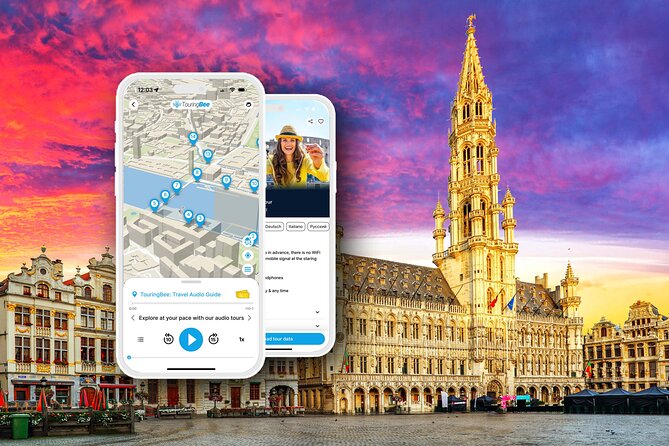
Brussels has a lot of sights, so pace matters. This self-guided smartphone tour strings together top landmarks with offline audio and a route you can follow on your phone. I especially liked the simple professional historian narration you can replay, and the fact that you can pause for cafes or museums without feeling rushed. One thing to consider: it is not a live guide, so you will need your own headphones and you still have to plan any paid museum entry tickets.
You start near Halle Gate and work your way through medieval corners, royal squares, major churches, and classic Brussels street life. The best part is control. If a street feels too loud, you move on. If a story hooks you, you rewind and catch it again.
The route is about 3 hours, but the experience is really as long as you want it to be because you set the tempo. For $8.46 per person, you get the app, offline map, and a full set of commentary, while the sights themselves are mostly free to view from the street or with free entry at the listed stops.
In This Review
- Key highlights before you set off
- Smartphone audio is the right move for Brussels
- Starting point at Halle Gate, then Marolles street texture
- Palace of Justice scale, then Sablon’s quiet Gothic
- BOZAR to Place Royale: art and politics in the same walk
- Royal Palace, Magritte, and MIM for a modern-brain reset
- Mont des Arts carillon, Smurfs Passage, and the cathedral stop
- Royal Gallery of Saint Hubert, classic bites, and beer culture
- Medieval corners, St. Catherine, Zinneke Pis, and the Stock Exchange museum
- St. Nicholas, Grand Place, and the guildhall masterpiece set
- Price and value: what you get for $8.46 per person
- Who this is best for, and who should skip it
- Should you book this smartphone Brussels walking tour?
- FAQ
- Is this Brussels walking tour self-guided or does it include a live guide?
- What language is the audio guide offered in?
- How long is the tour?
- Where does the tour start and where does it end?
- Do I need to bring headphones?
- Are museum or attraction entry tickets included?
- What equipment do I need to do this tour?
- How many audio recordings come with the guide?
- Is there a time window for when I can start walking?
- How many people are in the tour group?
Key highlights before you set off
- 34 audio recordings by a professional historian, so the facts come with context and a clear pace
- Offline map and GPS navigation, which helps a lot in busy central streets
- Free outdoor viewing at many stops, with entry tickets for museums not included
- A big, satisfying route density, meaning you see a lot even on a short day
- Headphones-friendly, rewindable audio, ideal if you dislike group tours or getting separated
- One-year access to the tour, useful if you want to repeat sections later
More Guided Walks in Brussels
- Brussels: Guided Walking Tour
★ 4.6 · 3,560 reviews - Brussels: Historical Walking Tour with Chocolate & Waffle Tasting
★ 5.0 · 1,165 reviews - Brussels Walking and Tasting Tour (Beers,Chocolates&Fries/Waffle)
★ 5.0 · 929 reviews - Brussels Chocolate Walking Tour and Workshop
★ 4.5 · 885 reviews - Brussels: City Highlights Walking and Tasting Tour
★ 4.9 · 505 reviews
Smartphone audio is the right move for Brussels
Brussels can feel like a “see it all” city. The trouble is that walking tours often move like clockwork, and you end up sprinting just to keep up. This format flips that. You download the app, activate your purchase, then follow the route on the app’s map while listening at your speed.
I love that you get 34 narrated recordings. That is a lot of story time for a short walking loop, and it means you are not just hearing directions. You are getting what to look for, why it mattered, and what legends are attached to the stones.
The drawback is also straightforward. This is self-guided, so there is no in-person guide to answer questions on the spot. If you like back-and-forth, or want help choosing which paid museum to add, you will have to do that yourself.
Starting point at Halle Gate, then Marolles street texture
Your walk starts by Halle Gate (Porte de Hal), the last surviving gate from Brussels’ 14th-century city wall. Right away you get a medieval tower rising against a modern backdrop. It used to serve as fortress, prison, and customs post, and today it is a museum of military and urban history, complete with armor and weapons.
What I like here is the contrast. Brussels has plenty of old churches and squares, but a defensive gate feels different. You can also look for the views from the upper ramparts, because the audio focuses attention on what to notice as you climb or lean in.
From there, head to Place du Jeu de Balle, known for its daily flea market. The square sits in the Marolles district, and the whole area has that mix of locals, bargain hunters, and curious strollers. Expect odd finds and secondhand treasures that are only half about shopping and half about browsing.
Practical tip: this is a great moment to slow down, because a market is one of those places where you can accidentally spend 45 minutes if the audio moves you just a little. If you feel yourself getting distracted, you can stop, rewind, and continue without losing your place.
Palace of Justice scale, then Sablon’s quiet Gothic
Next up is the Palace of Justice (Palais de Justice), a massive neoclassical courthouse that dominates the skyline. Completed in 1883 and designed by Joseph Poelaert, it is one of the largest courthouses in the world. Even if you do not go inside, the dome and the sheer size make you understand why this building symbolizes state power and legal authority.
The audio framing helps here. It treats the palace like more than a landmark. You hear about the blend of fortress-like feel and mythic ambition, plus the turbulent history that includes WWII damage and ongoing renovations.
Then the route shifts to a calmer pocket: Église Notre-Dame des Victoires au Sablon. This 15th-century Gothic church is known for stained glass, intricate stonework, and a quiet nave filled with light. It was built by the city’s crossbowmen’s guild, and the audio includes the legend tied to a miraculous Madonna statue brought by boat.
Right beside it is the Square du Petit Sablon, a garden with 48 bronze statues representing traditional medieval guilds. This is one of those stops where a guided voice helps, because it points you toward what each figure represents and where the garden’s symbolism is placed. At the center, you see the Counts Egmont and Hoorn monument, tied to 16th-century nobles executed for resisting Spanish rule. Their deaths helped ignite the Eighty Years’ War, a turning point toward Dutch independence.
A small consideration: these are compact, photo-friendly stops. If the weather is bad, you may want to keep moving and save longer museum visits for indoors.
BOZAR to Place Royale: art and politics in the same walk
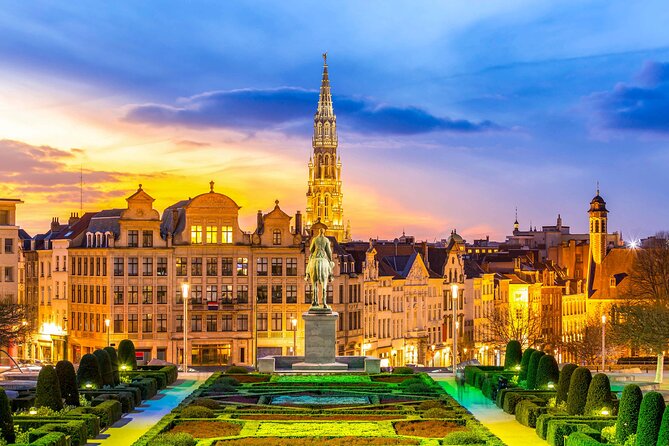
The next jump is cultural power in a single neighborhood. You pass BOZAR, the Palace of Fine Arts (Beaux-Arts) designed by Victor Horta in the 1920s. The building itself is understated, but the interior is where the energy is, with concert halls, exhibition spaces, and cinemas. If you like planning your day around art, BOZAR is a strong anchor point, because it regularly hosts symphonies, experimental art, and film festivals.
From BOZAR, you reach Place Royale, a grand neoclassical square laid out in the late 18th century. It is tied to the former Palace of Coudenberg, and the equestrian statue of Godfrey of Bouillon brings a crusader story into a royal-adjacent setting. This square works as a mental transition: the walk moves from medieval and civic space toward monarchy and national identity.
Beside Place Royale, you can visit BELvue Museum. It uses a theme-based approach to Belgian history, shaped around ideas like democracy, migration, industry, and identity. You also get an extra layer because under the museum are excavated ruins of the Coudenberg Palace. This is the kind of stop that pays off if you want context before you keep walking.
More Self-Guided Trails in Brussels
Royal Palace, Magritte, and MIM for a modern-brain reset
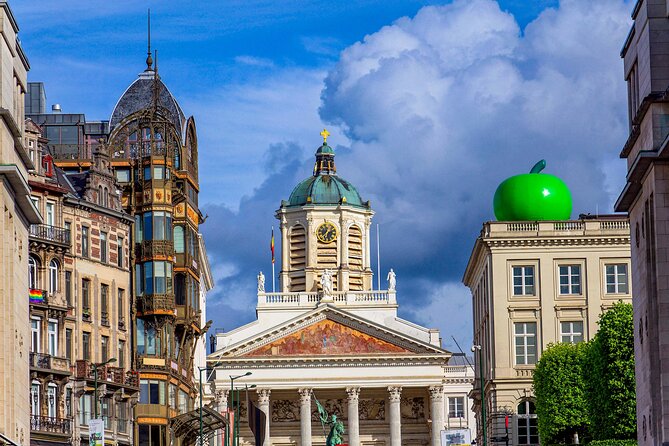
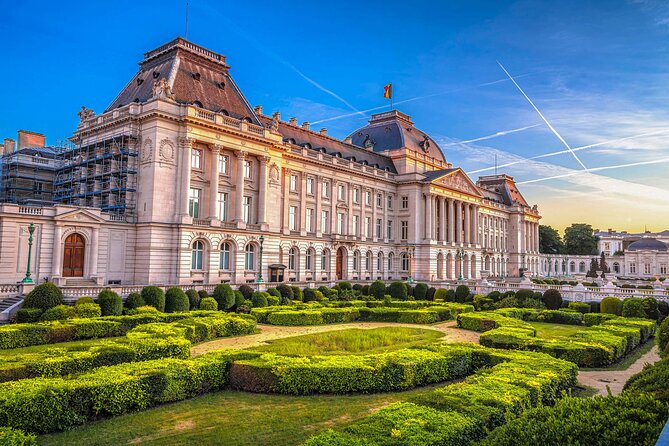
Next, you come to the Royal Palace of Brussels, the official administrative residence of the Belgian monarch, facing Brussels Park across Place des Palais. The king does not live here, but state ceremonies and receptions happen inside. The audio highlights the contrast between the neoclassical façade and richly decorated interiors, including the famous Mirror Room with a ceiling covered in iridescent beetle wings. This palace is open to the public each summer, so in some seasons you might only get exterior viewing.
Then you shift to surrealist thinking with the René Magritte Museum on Place Royale. This one is personal because it is housed in Magritte’s 19th-century home and studio from 1930 to 1954. The audio points you toward the objects that shaped his dreamlike images, including sketches, furniture, photographs, and everyday items.
After that, a fun stop for your senses: the Musical Instrument Museum (MIM), located in the Old England building. The collection has over 7,000 instruments from around the world. You get headphones, so you can hear what each instrument sounds like. This is one of the few places on the route where the audio experience can carry you even if you decide to go inside, because your ears are already trained by the narration.
If you want an easy pause, check the rooftop café for panoramic city views. It is a simple way to rest your feet without abandoning the “Brussels highlights” rhythm.
Mont des Arts carillon, Smurfs Passage, and the cathedral stop
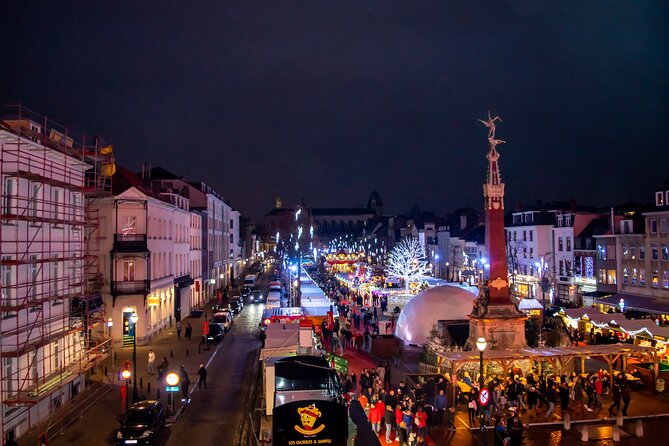
You then reach Carillon of the Mont des Arts, a musical clock perched along the Mont des Arts steps. It has 24 bells and 12 mechanical figures representing key moments and characters from Belgian history, such as Charles the Bold and Peter Bruegel. Every hour, one figure emerges and the carillon tunes in. The audio encourages you to look up, because you will miss it if you only watch street level.
Next is a playful palate cleanser: Smurfs Passage (Passage des Schtroumpfs). This is tucked inside the Galerie Horta near Brussels Central Station. You get vibrant murals, 3D figures, and a ceiling where the Smurfs look mid-adventure. The point is not education. It is permission to be cheerful during a long day of monuments.
Then comes a major spiritual and architectural anchor: St. Michael and St. Gudula Cathedral. This Gothic cathedral is Brussels’ national heart, with twin towers and a long-standing role as both a religious symbol and a ceremonial space. The audio focuses on the soaring vaulted ceilings and stained glass, with attention on how light fills the nave. If you go inside, treat it like a reset button.
Royal Gallery of Saint Hubert, classic bites, and beer culture
Now you enter a quieter, refined corridor: Royal Gallery of Saint Hubert. This 19th-century arcade, opened in 1847, is one of Europe’s oldest covered shopping galleries. Light pours onto marble floors, and it is lined with chocolate shops, jewelers, bookstores, cafes, and a historic theater. Even if you do not shop, the architecture and the walk-through feel like Brussels doing its Parisian impression.
For food, the route keeps it classic with Chez Léon, famous for moules-frites since 1893. It is a no-fuss, family-run place near the Grand Place with a vintage, cozy feel. If you want one straightforward meal aligned with the city’s identity, this is the kind of stop the audio won’t let you miss.
Then you hit Delirium Café, a beer landmark. It has a Guinness World Record-breaking menu of over 2,000 beers, with the well-known pink elephant logo. The vibe is more about fun and variety than fancy tasting. If you are a beer person, this stop is practically mandatory.
Right after that, the route goes slightly cheeky: Jeanneke Pis. This bronze statue shows a squatting girl installed in 1987. Protected by iron bars, it symbolizes gender equality and whimsy. It is not solemn, and that is the point. Brussels has always been good at turning political or social ideas into something people can smile at.
Medieval corners, St. Catherine, Zinneke Pis, and the Stock Exchange museum
After the Jeanneke Pis stop, the walk heads toward a rare survivor: Black Tower (Tour Noire). Dating to the 13th century, it was part of Brussels’ first defensive wall. You can see how the dark, weathered stone sits next to modern buildings. It is a quick stop, but it makes the city’s history feel physically present, not just museum-based.
Then you reach St. Catherine Catholic Church, a mix of Gothic roots and a 19th-century neo-Renaissance facade with hints of Baroque. The church sits on a site tied to a medieval harbor basin, and it was long surrounded by fish markets. Inside, you get a calm, spacious feeling with softer light filtering through tall windows and quieter chapels.
Next is Zinneke Pis, the final member of Brussels’ quirky urinating statue trio. It is a bronze dog mid-pee, installed in 1998 by artist Tom Frantzen. Unlike the others, Zinneke Pis does not involve water spouting. It is basically a street-level comedy beat, and it works well at the end of a long stretch of walking.
From there you can step into beer history at the Belgian Beer World Experience, located inside the Brussels Stock Exchange building (Bourse). This opened in 2023 and uses high-tech storytelling plus hands-on exhibits to cover the history and science behind Belgian brewing, spanning over 1,600 beers. There are interactive displays, scent stations, and a circular tasting hall with panoramic views. If you want one major indoor stop, this is your best match on this route.
St. Nicholas, Grand Place, and the guildhall masterpiece set
The next church stop is Church of St. Nicholas, dating back to the 12th century. It is a compact Gothic structure with a weathered, older look, set beside busy Rue des Fripiers near the old stock exchange area. Inside, it feels intimate and a bit darker than you might expect from its location, with artworks and a sense of continuity amid the city’s commerce.
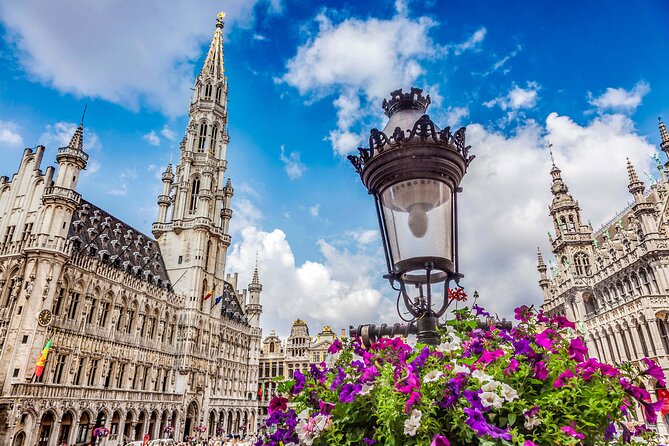
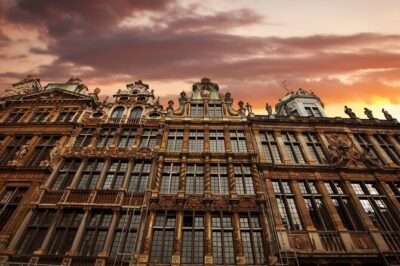
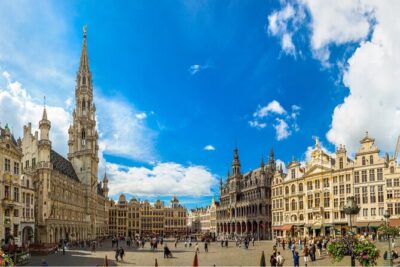
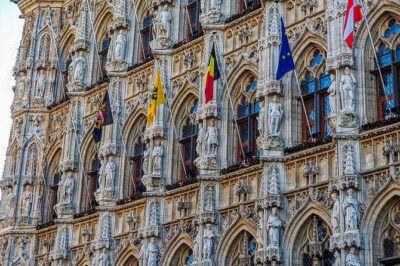
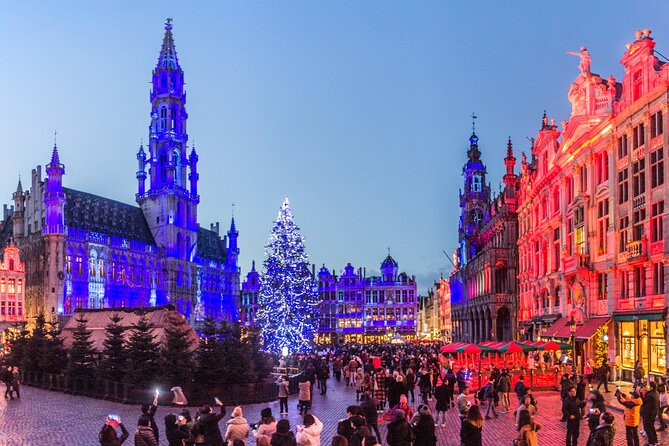
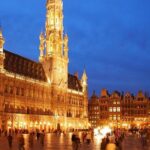
Then you reach the emotional climax of the walk: the Grand Place. This UNESCO World Heritage central square is framed by ornate guildhalls, the Town Hall, and the King’s House (Maison du Roi). It evolved from a medieval marketplace into a stage for civic pride. The architecture is meant to impress, and it does, with gold details, sculpted flourishes, and gables that reward close looking.
Right along the east side you see the House of the Dukes of Brabant, a row of seven unified guildhalls. Despite the name, no dukes lived here. It is a symbolic reference to past rulers. The facade was rebuilt after French bombardment, and it shows baroque unity with columns, statues, and gold trim. Today those spaces host shops and restaurants, so the square is history plus daily life in the same view.
Then, you finish with the most famous mischief-maker: Manneken Pis. This tiny bronze boy is only 61 cm tall, but he is Brussels’ icon. He has worn hundreds of costumes for holidays and visits, and the audio helps you understand why this small statue became such a big symbol. Expect a crowd here, even if the rest of the walk felt peaceful.
Price and value: what you get for $8.46 per person
At $8.46 per person, you are not paying for a guide, and you are not paying for museum tickets. You are paying for the convenience and storytelling. That includes an audio guide app for iPhone and Android, an offline map, 34 historian-narrated recordings, and illustrations to help you recognize landmarks, plus one-year access in your preferred language.
So what is the real value? It is the mix of structure and freedom. You still get a route that connects major sights, but you are not stuck behind a group. If you are the type who gets annoyed by waiting, or you want to spend time where you actually care, this pricing makes sense fast.
A consideration: because entry tickets are not included, you may pay extra if you add indoor museums like BELvue, BOZAR exhibitions, the Magritte Museum, MIM, or the Belgian Beer World Experience.
Who this is best for, and who should skip it
This walk is ideal if:
- you dislike group tours and want quiet control with headphones
- you prefer legend plus fact, delivered in plain language you can replay
- you want a high density of famous Brussels stops without planning each one separately
You might choose something else if:
- you strongly want an in-person guide to answer questions
- you plan to rely on paid museum time, because ticket planning is on you
- you are expecting the tour to cover everything inside major museums, since it focuses on the sights along the walk
Should you book this smartphone Brussels walking tour?
I would book it if you want a smart, cost-effective way to see a lot of Brussels with minimal stress. The standout strength is control, especially the rewindable historian audio that lets you move at your speed, not the tour’s.
I would not book it if you need a live guide, or if you expect all museum entry fees to be included. In that case, you would likely end up doing more ticket planning than you want.
Overall, for $8.46 per person, this is one of the better ways to handle Brussels at a walking pace, especially if you want the day to feel like your own.
FAQ
Is this Brussels walking tour self-guided or does it include a live guide?
It is self-guided. The format uses a smartphone app with an audio guide and an offline map, and there is no in-person tour guide.
What language is the audio guide offered in?
The tour is offered in English, and the audio guide is available through the mobile app in your preferred language.
How long is the tour?
The duration is approximately 3 hours.
Where does the tour start and where does it end?
It starts at Halle Gate, Bd du Midi 150, 1000 Bruxelles, Belgium. The activity ends back at the meeting point.
Do I need to bring headphones?
Yes. Headphones are not included, so you will need your own to listen to the audio guide.
Are museum or attraction entry tickets included?
No. Entry tickets are not included and must be purchased separately in advance.
What equipment do I need to do this tour?
You need a smartphone. The audio guide is accessed via a mobile app for iOS and Android, and you follow the route using the app’s map.
How many audio recordings come with the guide?
There are 34 audio recordings narrated by a professional historian.
Is there a time window for when I can start walking?
You can start within the listed opening hours, Monday through Sunday from 7:00 AM to 8:00 PM. The exact start time at checkout is approximate.
How many people are in the tour group?
The activity has a maximum of 20 travelers.
Latest from Brussels




Walking Tours, compared.
Small Group Boat Cruise and Guided Walking Tour
Read our review →
Historical Walking Tour with Chocolate & Waffle Tasting
Read our review →
Brussels Walking and Tasting Tour (Beers,Chocolates&Fries/Waffle)
Read our review →
Browse the lists this tour appears in