
Reviewed · CHOCOLATE MAKING WORKSHOPS
Small-Group Tour of Bruges hightlights with a local. Free Praline
Bruges tells its story in 2 hours. I loved how local guide Nick turns each corner into something you can understand, not just a photo spot, and I also liked the sweet payoff: a free praline plus a taste at Pur Chocolat. The main thing to consider is that many stops are brief, so if you want long stays inside big sites like Onze-Lieve-Vrouwekerk or Gruuthusemuseum, this format will feel fast.
Starting at Markt and ending near the Halve Maan beer pipeline keeps the walk logical. You get a mobile ticket, the tour runs in English, and it is a small group of up to 24 people, which helps you ask questions without shouting.
This is an easy-value way to get your bearings in Bruges, especially if it is your first time or you only have a short window.
In This Review
- Key highlights you should know before you go
- Where the tour starts and ends, and how that helps
- The Markt to Belfort stretch, Bruges’ power in plain sight
- Burg Square and Vismarkt, where the medieval city began
- Huidenvettersplein and the canal edge, leatherwork and riverside trade
- Boniface Bridge, with a funny reality check
- Gruuthusemuseum, then Onze-Lieve-Vrouwekerk for art and brick-baked drama
- Saint-Janshospitaal and Godshuizen, medieval care you can still picture
- Stoofstraat to Pur Chocolat, when the route turns sweet
- De Halve Maan brewery and the underground beer pipeline
- The practical stuff that affects your day
- Is it worth the $3.54 price tag?
- Should you book this Bruges highlights tour?
- FAQ
- How long is the Bruges highlights tour?
- What language is the tour offered in?
- What group size should I expect?
- Where do I meet the guide, and where does the tour end?
- Is food included?
- Are admission tickets included?
- Can I get a full refund if I cancel?
Key highlights you should know before you go
- Nick’s explanations that connect power, trade, and everyday life
- A short, well-paced loop through Bruges’ key squares and canals
- Free admission tickets at the stops on the route
- Pur Chocolat Artisanale Chocolatier, plus a real Belgian truffle tasting
- Onze-Lieve-Vrouwekerk spire (122 meters) and major art inside
- Halve Maan, where beer literally moves underground
More Chocolate Tastings in Bruges
- Bruges: Choco-Story Museum with Audio Guide and Tastings
★ 4.2 · 1,825 reviews - Belgian Chocolate Workshop in Bruges
★ 5.0 · 660 reviews - Bruges: Belgian Praline and Mendiants Chocolate Workshop
★ 4.7 · 620 reviews - Choco-Story: The Chocolate Museum in Bruges
★ 4.0 · 544 reviews - Bruges: Chocolate Making Workshop and Chocolate Museum Entry
★ 4.6 · 395 reviews
Where the tour starts and ends, and how that helps
The meeting point is at Markt 7, right in the middle of Bruges where most first-time wandering starts anyway. You begin with the city’s main square, then you move outward in a way that feels like a story, not a random checklist.
The tour finishes at Huisbrouwerij De Halve Maan, at Walplein 26, at the area tied to the brewery’s underground pipeline. The good news is that if you need to get back to the Markt, it is about a 10 minute walk. That matters because you are not left stranded at the far end of town.
This is also the sort of route that works well even if you are arriving on public transportation. The timing is set for 11:00 am, so you are seeing the city while the streets are active, but not at the latest evening rush.
The Markt to Belfort stretch, Bruges’ power in plain sight
Your first stops set the tone. Markt is where the city’s rhythm shows up fast. The tour frames it as the rise and fall of Bruges, which is a useful way to look at what you are seeing. Instead of treating buildings like scenery, you start noticing who had power and why the city mattered.
Then you move to Belfort, the Belfry. The Belfort is presented as a sign of wealth and power, and it is an easy concept to grasp on-site. When you see it, you get why medieval cities built tall, visible symbols that declared status.
Each of these early stops is short, around 10 minutes. That can feel like a sprint if you like to linger. But in exchange, the route keeps momentum, and you get to cover a lot without burning the day.
Burg Square and Vismarkt, where the medieval city began
From the Markt area you head to Burg Square, described as the oldest square of Bruges, where the city actually started. That label changes how you look at it. Even in a brief visit, you can sense why this is the kind of place people would gather when the city was young and focused on survival and trade.
Next comes Vismarkt, the Fish Market area. The market itself does not run like it used to, with daily stalls, but the place still carries that medieval trade connection. You also still find fishmongers and seafood vendors nearby, so it does not feel completely ceremonial.
This part of the walk is great if you like “why this place exists” stories. It is also a good reset for your feet, since the square-to-square pace stays manageable.
Huidenvettersplein and the canal edge, leatherwork and riverside trade
After the main squares, you get a more textured look at the city’s past. Huidenvettersplein, Tanner’s Square, points to Bruges’ medieval leatherworking industry. You learn the area was named for the tanners, the people who worked hides there.
That is the kind of detail I appreciate on a highlights tour. Bruges is easy to admire. It is harder to understand. Tanner’s Square gives you a human job story, which makes the city feel lived-in instead of museum-only.
Then you shift toward the waterways. The Rosary Quay (Oosterstak) is described as a picturesque canal-side area with medieval trade and transportation significance. After that, you pass by Dijver, a canal in the city center known for scenic views and historic buildings lining the water, including former warehouses and homes. Boat tours operate from the canal area, so even if you do not take one, you get the visual rhythm of Bruges along the water.
More Local Favourites in Bruges
Boniface Bridge, with a funny reality check
Boniface Bridge is next, also known as the Bridge of Love. On this tour, there is a bit of playful skepticism about that nickname, with the guide pointing out that the name might not be the best fit.
I like this moment because it prevents the walk from becoming too reverent. You are learning, but you are also allowed to notice what feels accurate and what feels like a marketing label.
It is a short stop, about five minutes, so treat it as a quick photo and a quick story beat, not a full attraction.
Gruuthusemuseum, then Onze-Lieve-Vrouwekerk for art and brick-baked drama
Gruuthusemuseum is housed in a grand 15th-century mansion that belonged to the Gruuthuse family. In the time you spend there, you see what makes it matter: collections tied to Bruges’ past as a medieval trading power, plus fine arts, tapestries, medieval weaponry, and decorative objects.
The visit is brief, around five minutes, so you will not leave feeling like you mastered the museum. But you will understand the building and what kind of collections you are looking at. That makes it a strong “want to know more” stop.
Then the tour moves to Onze-Lieve-Vrouwekerk, the Church of Our Lady. This is a big one. The spire is 122 meters, and it is described as one of the tallest brick structures in the world. The church dates from the 12th to 15th centuries, and it houses major artworks, including Michelangelo’s Madonna and Child.
On this route, you can also catch a glimpse of the Marble sculpture Madonna and Child during a Nostalgic Tour format. If you care about art, this is the kind of highlight you remember because it links scale (that spire) to real subject matter you can look for inside.
One consideration: if you want a slow, quiet visit, this stop might feel like a snapshot. Still, as part of a two-hour circuit, it is an efficient way to hit a centerpiece.
Saint-Janshospitaal and Godshuizen, medieval care you can still picture
After the big art stops, the pace shifts into something more human. Sint-Janshospitaal, Saint John’s Hospital, is one of the oldest and best-preserved medieval hospitals in Europe. It was founded in the 12th century, originally serving the poor and sick.
Even in a short five-minute stop, this is the sort of place that sticks in your mind because it is not about power symbols or trade squares. It is about care. The building and its role give you a different angle on how medieval Bruges worked.
Next up are the almshouses called Godshuizen. The tour frames them as historic shelters that provided care for the poor and elderly, dating back to the 14th century. Many are near canals with peaceful courtyards. Some still serve their original purpose, while others are restored and open to the public.
I like pairing these two stops, hospital then almshouses. You get a fuller picture of community responsibility, and you see how those ideas shaped the city’s layout.
Stoofstraat to Pur Chocolat, when the route turns sweet
Stoofstraat is a short walk, about five minutes, but it has a clear story. The tour notes the street dates to the medieval period as a key route, and its name is connected to the old Dutch word stoof, referring to a heated room or chamber. The implication is that nearby buildings had heating systems tied to that idea.
Then comes the payoff for food lovers: Pur Chocolat Artisanale Chocolatier. Bruges has 77 chocolate shops, but only 11 are artisanal, and this stop focuses on one of those. You also get a chance to try a real Belgian truffle.
On top of that, the overall tour includes a free praline. That combination makes this feel less like a token snack and more like an intentional taste stop. If you have ever felt let down by “one bite and move on” tours, this one is set up to give you a real taste moment.
De Halve Maan brewery and the underground beer pipeline
The final stop is De Halve Maan, famous here for its underground pipeline that transports beer to the bottling plant. The tour points out this is literal, not poetic. You see the idea connected to the end location, which also explains why the route finishes there.
This is a good closure because it ties back to the theme you have been hearing since the start: Bruges as a place shaped by trade, production, and infrastructure. Squares and churches showed power. Canals showed transport. The brewery shows how goods still move through systems, just with modern plumbing.
Even if you do not spend time deeper in brewery operations, the pipeline concept alone gives you a fresh mental image of the city.
The practical stuff that affects your day
This tour runs about two hours and covers a lot of ground on foot. Many stops are around five to 10 minutes, which makes it efficient but also means you need realistic expectations.
Group size is kept to a maximum of 24 people, and it is offered in English. I found that this kind of group ceiling helps guides keep the flow moving without losing the ability to explain.
You also get free admission tickets for the stops on the route, which is a big value point. It means you are not paying separately to access the buildings and sights included in the highlights.
If you want to ask questions, bring them early. The guide, Nick, is singled out in the overall experience for being warm, funny, and entertaining, and that kind of hosting style makes the short stops feel less rushed.
Is it worth the $3.54 price tag?
That $3.54 per person price is unusually low for a structured two-hour walk that includes free admission tickets, a free praline, and multiple major landmarks. Even if you think some of the stops will be brief, the mix still gives you a lot of “saved time” value.
What you should keep in mind is that this is a highlights tour, not a museum marathon. You are buying guidance and access, plus a guided route through Bruges’ key spaces, not unlimited time inside every site.
If you are traveling on a budget or you are time-limited, this is exactly the kind of pricing that makes planning sense. If you love slow, detail-heavy visits, you can still use this as a first orientation, then return on your own to the places that pulled you in.
Should you book this Bruges highlights tour?
Book it if you want to see the main Bruges hits in one smooth walk, with a local guide named Nick who explains the why behind the big sights. The free praline, the artisanal chocolate stop with a real Belgian truffle tasting, and the inclusion of free admission tickets make it a strong value choice.
Skip or supplement it if you know you will be frustrated by short visits. If your ideal Bruges day is 60 minutes in a single church or museum, plan extra time after the tour to revisit the places that hook you.
If you are on a tight schedule, this is one of the smart ways to get your bearings fast, learn the main stories, and still leave room for your own wandering.
FAQ
How long is the Bruges highlights tour?
It runs about 2 hours.
What language is the tour offered in?
The tour is offered in English.
What group size should I expect?
The tour has a maximum of 24 travelers.
Where do I meet the guide, and where does the tour end?
You meet at Markt 7, 8000 Brugge, Belgium. The tour ends at Huisbrouwerij De Halve Maan, Walplein 26, 8000 Brugge, near the brewery pipeline. You can walk about 10 minutes back to the Markt area if you need to.
Is food included?
Yes. The tour includes a free praline, and at Pur Chocolat Artisanale Chocolatier you get a chance to try a real Belgian truffle.
Are admission tickets included?
Yes. The stops on the route list free admission tickets.
Can I get a full refund if I cancel?
Yes, free cancellation is available. You must cancel at least 24 hours in advance of the start time for a full refund.
Latest from Bruges
Chocolate Making Workshops, compared.

Choco-Story Brussels: Chocolate Museum Entrance with Tasting
Read our review →
Hungry Mary’s Famous Beer and Chocolate Tour in Brussels
Read our review →
Choco-Story Museum with Audio Guide and Tastings
Read our review →
Belgian Chocolate Making Workshop with Tastings
Read our review →
Historical Tour with Chocolate & Waffle Tasting
Read our review →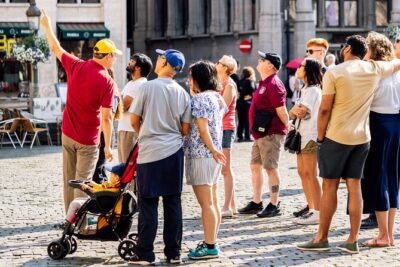
Historical Walking Tour with Chocolate & Waffle Tasting
Read our review →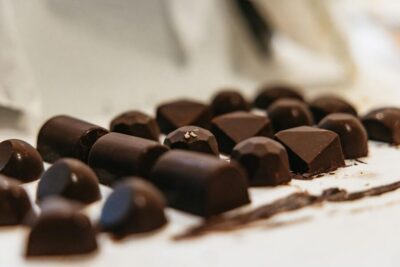
Browse the lists this tour appears in